

I am testing out a new layout this week, let me know what you think. The first sections will include content that was produced or released from the week followed by a few interesting articles or studies that I have discovered throughout the week pertaining to meaning, recovery or addiction. Finally, I will do a longer form dive into a topic of choice for the week. Skim and skip ahead to what interests you most.
If you have been following along for the last few months, or dove into the content on the homepage, leave a comment or send me a note about what you think! I love hearing from readers and I want to keep delivering the highest quality content, so let me know your thoughts about the change in layout!
Podcast Release(s)
Find the podcast on your streaming platform of choice: YouTube, Apple Podcast, Spotify.
The last few weeks saw the release of Lucy’s Story as well as the beginning of a short Pillars of Recovery series. I released the Intro and the Emotional Fitness podcast over the past couple of weeks.
I continue to be so damn proud to be Lucy’s father. She was such an inspiration and had an incredible heart. I find myself with her on my mind every waking hour of the day.
The Pillars of Recovery has me very excited about a mindset shift that I have had in my time in active recovery. I sincerely believe these pillars have applications well beyond the world of addiction and recovery, I feel they can be used for everyone’s betterment of their own lives in our pursuit of meaning. More to come in the next three weeks on the Pillars of Recovery.
The Emotional Fitness pillar of recovery gives an overview of the concept as well as some tactical advice for how to improve your emotional fitness. What continues to amaze me is how applicable these pillars are to every day well-being beyond improving the addicts situation.
Interesting (Enough) Articles
April being Alcohol Awareness Month (which I was ironically not aware of until just a few days ago), I will make this section specific to Alcohol content. These are articles that apply not just to the addict.
What Are Alcohol Shakes (Tremors)
This one hits home. This was the most frustrating (yet lowest risk) physical manifestation that I had while detoxing. Tremors would drive me to drink as consuming only a few alcoholic beverages would stop the shaking.
Stop Using Alcohol to Cope with Grief
Almost every day I thank God I found myself on a path of active recovery before the difficult parts of Lucy’s life began.
What is Sudden Onset Alcohol Intolerance
I don’t believe that I ever suffered from this specifically, but every once in a while I would notice my body reacting to certain kinds of alcoholic drinks differently. It’s why my drinking pattern and preference became very predictable at the end, to minimize such instances.
Weekly Long(er) Form: Guilt vs. Shame
Over a dozen years ago, if asked what the difference between guilt and shame were, I wouldn’t have an answer for you. In my mind, and based on my experience, they seemed to be nearly perfect synonyms. After a 12 year battle with alcohol that included a level of intensity on the shame front that is hard to fathom even as I write this, I feel like I can provide you a better answer to that question.
The critical importance of this topic is to reflect on your own life and understand how you fall out on the guilt vs. shame classification. I am going to write this post without looking to any formal definition for each word. I would like to portray my story to you and paint the picture of how crippling a shame first mindset of the world can be versus what can actually be a healthy guilt first mindset.
I see it this way - you have an action occur in your life. That action, in this case, is not aligned to your moral code or standard. Say you lied, yet one of your core values is honesty. That’s a deviation from moral code. A guilt mindset gets a level of discomfort over this deviation, but you are focused on the act itself and generally you have a drive to make amends for that deviation. A shame mindset looks at that deviation and goes, ‘see this is more proof that I am a terrible and flawed person’.
Without realizing it, in the depths of my hell with my alcoholism, I placed so many of my actions and thoughts in the shame bucket that I was quickly building a case for why I was a completely worthless human-being. Given enough time and intensity, this default thought process to be ashamed of myself as a human rather than be guilty for the specific action I had taken led me to the ultimate decision that I was not worthwhile and my life lacked purpose.
Towards the end of my drinking, I was thinking about my death a lot. If you’ve listened to any of my story you know that there was a strange suicidal pull in the very last days of my drinking, but the days and months leading up to that had me envisioning, and almost fantasizing, about my end of days on this earth. For some God awful reason, being t-boned at a very specific intersection played very vividly in my mind. Having the alcohol consumption slowly shut down my bodily systems was another very real visual that played out in my head.
The ending of all of these scenarios was the relief of a spirit that was trapped in a life where there was no sense of purpose or love, only shame. I realize now that shame was so overwhelmingly consuming of my self-perception that I needed such a life altering disruption as rehab in order to begin addressing the fact that I had amassed significant amount of shame in who I was as a person.
As I began the process of entering into a life of active recovery I began to realize that over the years I had shifted small instances and feelings of guilt over specific situations into powerful perceptions of shame over who I was as an human-being. I felt guilt over stupid or regretful actions, but instead of addressing them, learning from them and moving forward, I instead allowed them to shift into shame over who I fundamentally was as an individual.
Guilt, when dealt with as close to the moment of regretful action as possible, is a normal and healthy part of being human. It shows that there is some type of moral code that you hold yourself to, and that deviation from this code caused some uncomfortable feeling to arise within you. Generally, a heartfelt apology and a few minutes reflecting back on the thought or action that made you feel guilty, with a real plan for how to address some similar situation in the future, should more than suffice to turn guilt into a positive experience.
Left unchecked, though, a series of thoughts or actions that lead to guilt can shift from an opportunity into an overwhelming sense of, ‘what is wrong with me?’ that opens up the door for shame to enter in. Shame, unlike guilt, cuts more fundamentally into the core of your perception of you as a human.
Feeling shame for your deviation from your moral code is not so much a learning opportunity as it is a high risk scenario of feeling a sense of, ‘what is wrong with me as a person?’. This thought pattern is much more difficult to create a learning opportunity from as it cuts to the core of your value and meaning as a human being.
Guilt is thinking, ‘why did I do that stupid thing?’ whereas shame is thinking, ‘of course I did that stupid thing, I am a stupid person.’ I am naturally a self-critical person with high expectations (or at least I used to be) for myself. When my alcoholism really grabbed a hold of me, this self-criticality coupled with continued behavior that I knew was not in line with my moral standards, led me to truly believe that I was a terrible individual.
This perception led to incredible amounts of self-hate, physically manifesting in self-harm and a genuine desire to see myself hurting. I could not look myself in the eyes in the mirror. This is why I believe the promise that I made myself in rehab to look in my eyes in the mirror and say ‘I love you’ out loud to myself was so powerful. It allowed me to start transforming that deep self-hate that was rooted in shame and become more forgiving of myself.
In turn, this change allowed me to constrain any feelings of regret associated with my actions to the action itself and not persist down to the level of despising myself due to being a critically flawed human being. When I screwed up, I apologized or learned from the mis-step in action that I took and I moved forward. No longer were these actions that made me feel guilty for being out of line from my moral standard seeping into the perception that I had for myself as a human being.
A big part of putting in the step work with Alcoholics Anonymous is to “clean house”. On your first pass through the 12 steps, you are dealing with a near lifetime of behaviors, regrets and resentments as you work to clear the wreckage of your past. The beautiful thing about the steps work is that it shows you that, while flawed, you are a worthwhile being and additionally, once you do the work and get your house clean it is much easier to spot and address any clutter that finds itself into your space.
So after all of this writing, I suppose it’s time to give a look up to some actual definitions of guilt and shame. With this entire experience that I have had, I am really working on clarifying and understanding principles and then going to external resources to see how they map against what the human experience has already defined.
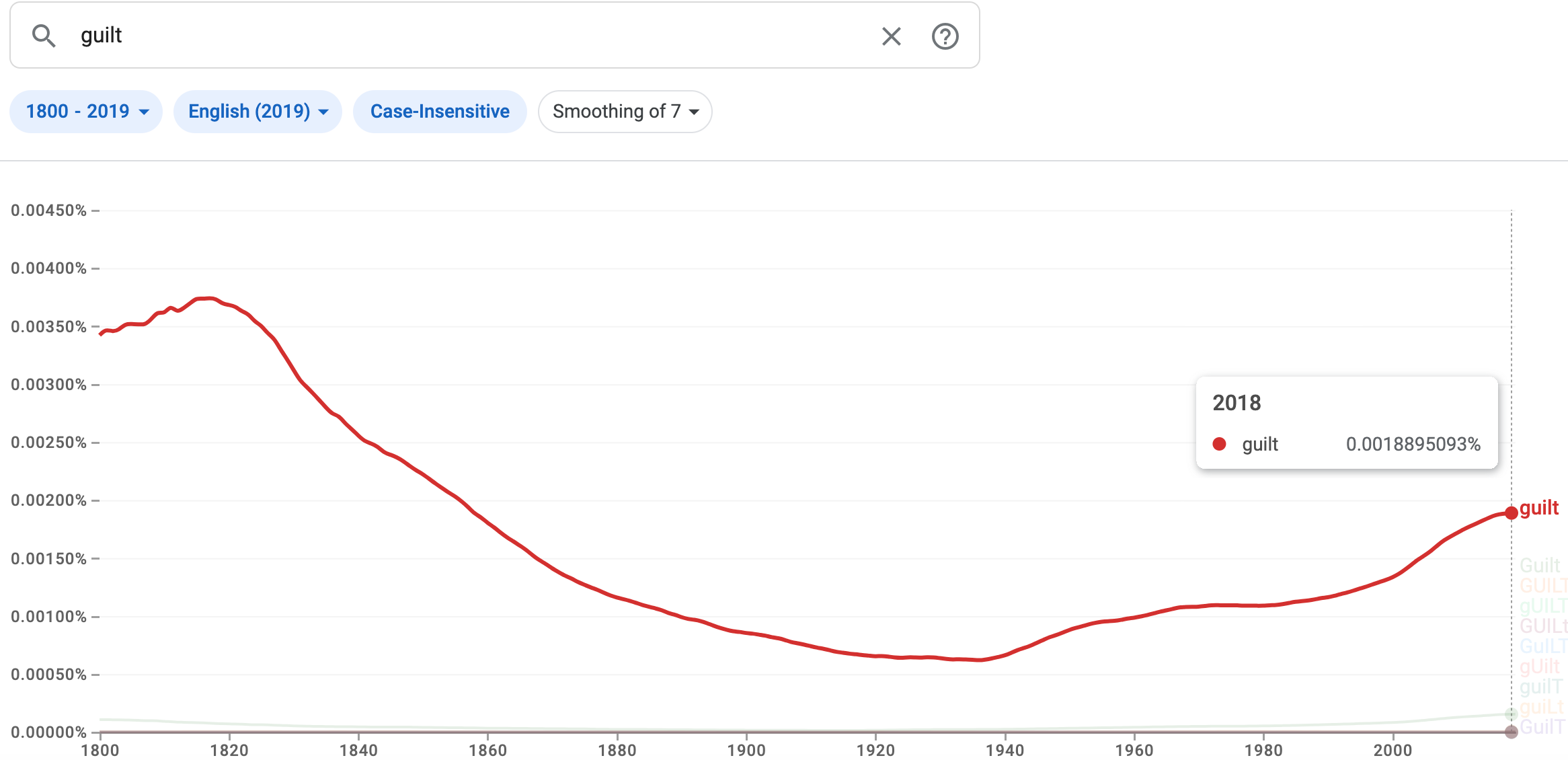
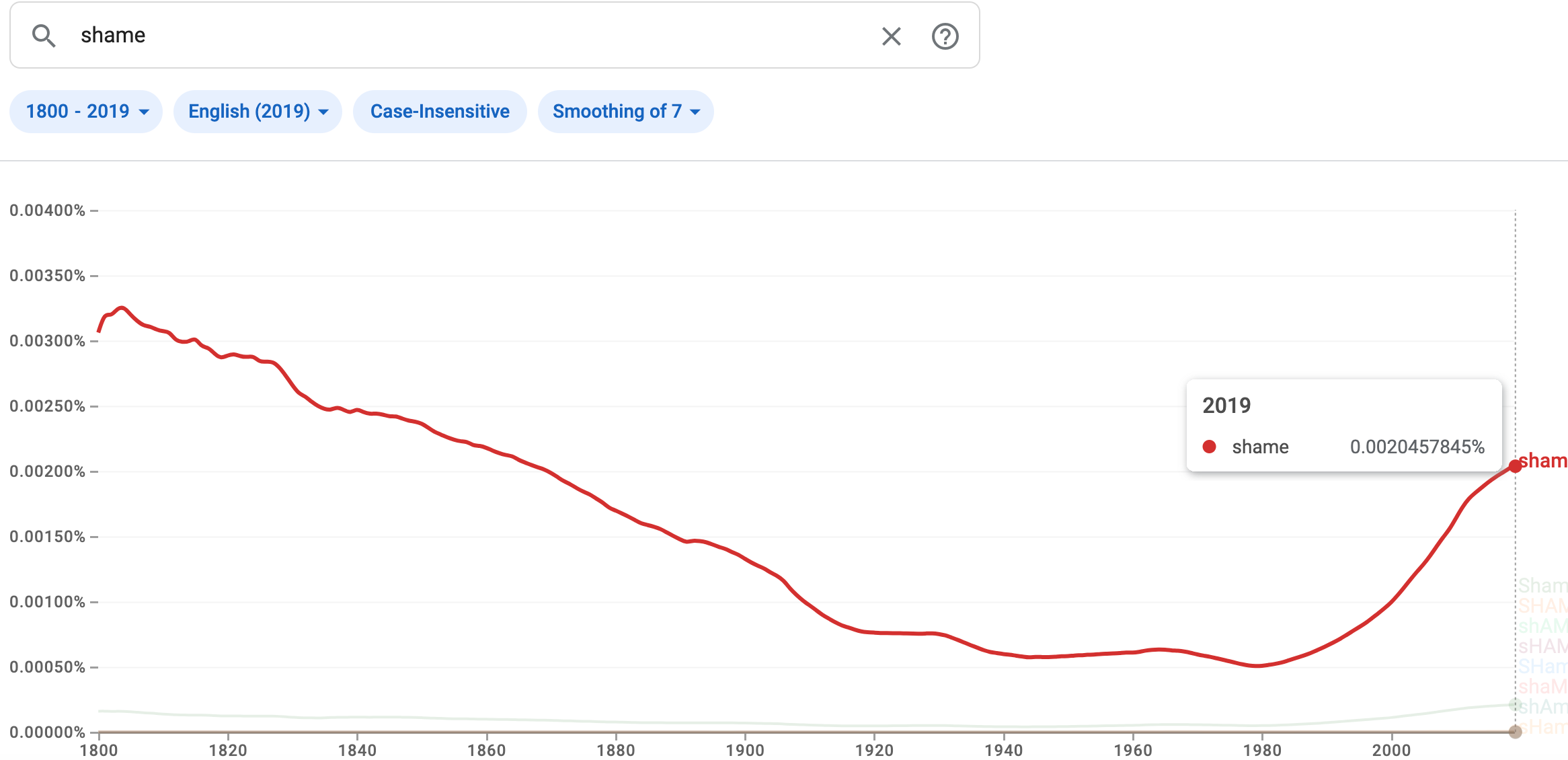
In taking the above action, I found something terribly interesting. There are charts online that will show the prevalence of word use over time. Look at the charts below, and notice since about 1990 the difference in the rate of change between the use of guilt vs. shame. Shame is kicking ass while guilt has a seemingly gentler rise. Both trends are somewhat confusing and concerning, and I offer no conclusions other than to ask you to stop and think about how you view regretful actions. Do you log them as a mistake, make amends and move forward? Or, do you log them as another proof positive that you are a terrible person?
That’s all I’ve got. Thanks for reading.
Kyle Zibrowski