

I am stealing from myself for this week’s post. The write up below was done following my 5 day backcountry elk and deer hunt in 2023, months after I left rehab and a few weeks after we found out about Lucy’s health condition.
There’s a detail about rehab that I have not yet shared before. I realized in my first few days that I was obsessing over being as efficient as possible as I moved throughout the facility. In the mornings, I would get coffee, stop in the bathroom, go to the nursing station for pills and wind up back in my room before sessions began. I found myself charting out the optimal course for action to achieve all of those steps with the obsessive goal of taking as few physical steps as possible to accomplish them all.
And then I asked myself something. Why does it really matter at all to be so focused on efficiency over such simple tasks? I had for so long obsessed over small efficiency gains and pushing things to be as close to perfect as possible that I found myself in rehab separated from my family for twenty-eight days. So I decided to say screw efficiency and I deliberately went out of my way to be as inefficient with my movements as I possibly could. And you know what? It felt oddly good.
This post is an outcome of my thinking about efficiency, and my realization that I actually wanted to introduce more inefficient moments in my life, and how much better I have felt as a result of dropping this obsessive pursuit over efficiency and perceived perfection.
Our culture is obsessed with efficiency. Minute rice, The 4-Hour Work Week, instant coffee, the list goes on. However, I had a revelation while out in the mountains this past weekend. I realized that the most enjoyment and satisfaction that I get out of my time in the mountains, and really out of life in general, is when I fully embrace and strive for inefficiency. Let me explain…
The Principle of Efficiency
Quick back story here to set the stage. I studied Mechanical Engineering in my undergrad days. I particularly had a passion for combustion and fluid systems. My dream job was working on large energy producing systems and to work on the power equipment such as turbines or turbo jet engines. This passion naturally led me down the path of taking A LOT of thermodynamics, heat transfer and fluid classes.
I went to a great public Engineering school. There were professors there that literally wrote the book on their subjects. Despite that, the stand out best instructor that I ever encountered was Dr. Hage. He was “just” an Associate Teaching Professor at the time, yet his approach and method blew every other instructor out of the water. For both assignments and exams, we were not allowed to use calculators or even write any numbers down. Dr. Hage wanted you to understand the working principles of the topic, and so literally would mark you down if a single number appeared on your answers. You’d be surprised how many engineers couldn’t resist pulling their calculators out…
Dr. Hage had this incredible way of distilling complex equations or systems down to digestible and easy to remember principles. While on a long walk this weekend my mind started wandering back to some of Dr. Hage’s lessons and the concept of system efficiency came to mind. Here is how we were taught to understand efficiency.

Be Inefficient If You Want Success
As I thought about this principle, I realized that I had been applying it to my outdoor experiences for a number of years. I am going to take a moment to explain how we can play around and modify efficiency given this understanding. I don’t intend to treat you as if you don’t recall your math lessons from 4th grade, I just want to be as clear as possible about how I think about efficiency.
If you want efficiency to go up (and efficiency can NEVER be greater than 100%), then you have two alternatives. Increase the value of the numerator (What You Want) or decrease the value of the denominator (What You Put In).
That’s straightforward enough. Now I am going to say something that I believe is severely underrated, but if you buy into this line of thinking, and start practicing it I think it will change not only your hunting experiences, but your entire life.
Striving for inefficiency is the key to finding joy and satisfaction in all of life’s situations, not just hunting.
How could this be? Simply stated, I have found that when my expectations are low (What I Want) or the amount that I am willing to sacrifice for a certain goal are significant (What I am Willing to Put In), that I get the most joy and satisfaction from the pursuit and attainment of what I am striving for at the moment. I’ll explain more through the lens of hunting and outdoor adventure.
The Numerator - Set Your Expectations Low
I feel lucky that on my first solo backcountry hunt that I sat down and thought through what would make this hunt a success. I was driving 1,800 miles from my home in Minnesota to Northern Idaho for the hunt. I was taking significant time off of work, of which I didn’t have much at the time, and I was spending hours thinking and planning for this hunt.
With all of that effort being put into the execution of this hunt (more on that next), what was I hoping to get from this adventure in the backcountry? In trying to answer this question, I came up with my hunting hierarchy. It constitutes a set of experiences that could happen on my hunt, but the only one that I truly desired was the foundational one. I constantly come back to this hierarchy before, during and after hunts over and over to make sure that I am still grateful for the time that I get out in the woods. It helps me set my numerator for the hunt or experience low, therefore reducing my efficiency. My hierarchy goes like this:
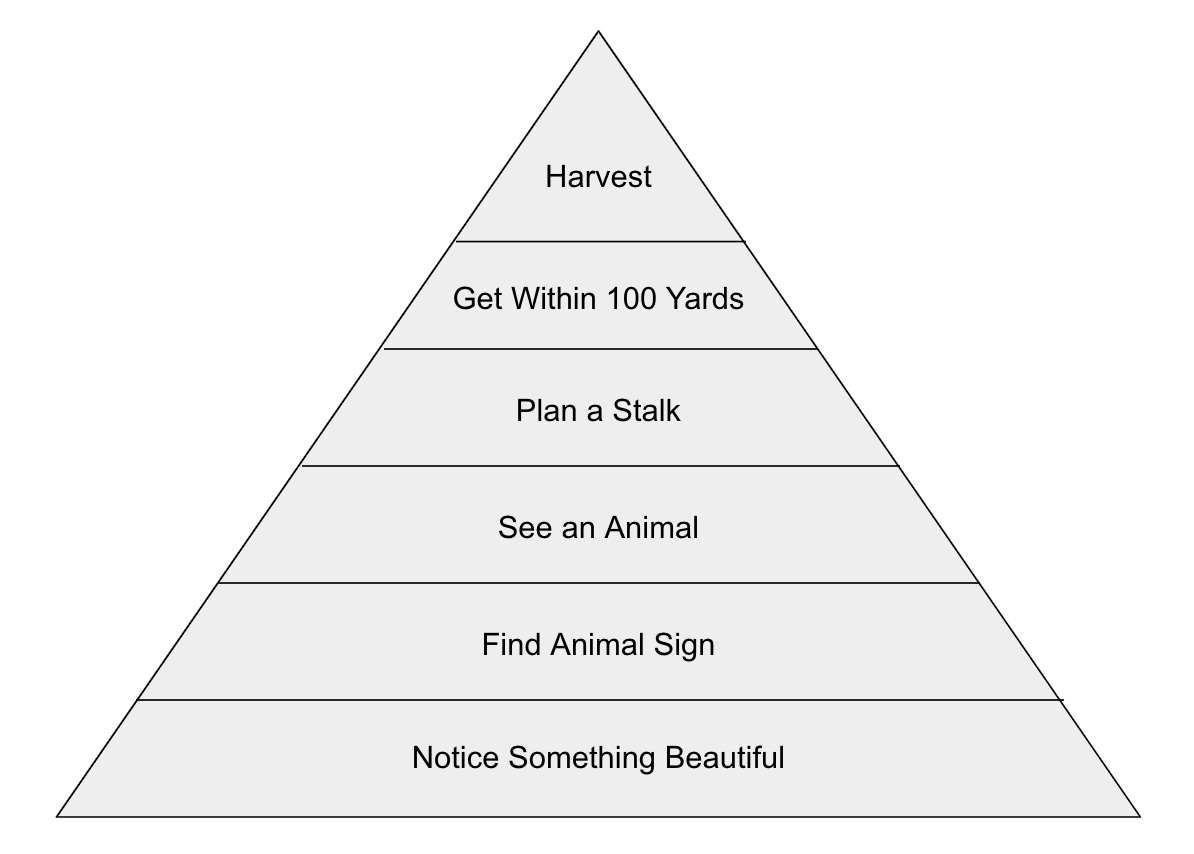
The expectation for my hunts, which are usually multi-day journeys into rugged mountains, is just to have an experience where I notice something beautiful. It could be a big landscape as I stand on a ridge line or simply a flower that is somehow growing straight out of granite. One simple acknowledgement and awareness of something that captures my eye as beautiful is all that it takes for me to deem a hunt successful. Everything else is just a cherry on top.
The Denominator - Be Willing to Work
In the previous section we worked towards lowering the numerator to help us become more inefficient in the field. This section will focus on how to increase the denominator, thereby reducing efficiency even further. To me, influencing the denominator comes down to one simple idea - find obstacles and overcome them.
If I had to describe my hunting strategy in a single statement, I would say “I find really unsexy areas and hunt there”. I have started to notice that when I focus on areas that contain barriers to entry and landscapes that don’t belong on magazine covers, that there are far fewer people there and plenty of animals. A few miles of deadfall? Fantastic. Stream crossings? Count me in. Long hikes? I’ll just pass the time humming the latest song my 2 year old is obsessed with. Low success rates? Why not?
Each of these barriers reduces the amount of pressure the animals will be under and I have found that it just makes the hunt more enjoyable as you work through each obstacle and find yourself more and more alone in the backcountry. Let me ask you this, what do you get more satisfaction from - a gulp of water after sitting on your ass for the last two hours watching some pointless TV program, or that same volume of water gulped down after hours of strenuous work hiking or working out? The work leads to the satisfaction. I am convinced of this.
Inefficiency for Life
So there it is, a rambling post on some thoughts that streamed through my mind as I took my 13 mile route back to my truck versus the more direct 3 mile route. I had the time, I wanted to see and experience new space, so I just did it. I found profound enjoyment on that walk back and I was able to think through and process this idea of striving for inefficiency in my hunts and in life. Keep your expectations low and be willing to bust your butt for it, and you’ll separate yourself from the pack in hunting situations and in life.
That’s all I’ve got,
Kyle